
|
A.afarensis |
|
P.boisei
|
|
H.rudolfensis
|
|
H.habilis
|
|
H.ergaster
|
|
H.heidelbergensis
|
|
H.neaderthalensis |
|
H.sapien |
|
HOME |
|
Map of Museum |
 |
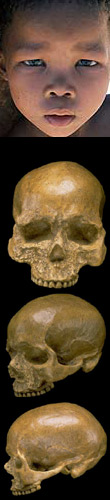
DiscriptionOur own species, Homo sapiens, evolved in Africa around 150,000 years ago. Homo sapiens have a characteristic look: their faces are small and tucked under a high, domed braincase. They have small eyebrow ridges and their lower jaw ends in a prominent chin. On average, their bodies are less muscular than those of earlier hominids. The appearance of modern humans coincides with the appearance of highly crafted tools, efficient food-gathering strategies and a complex social organisation.Early modern humans lived in mobile groups and established extensive social networks to trade goods and exchange gifts. These networks probably developed for the purpose of securing future favours when times were hard. And it seems that times were indeed hard for some of the first modern humans.
Flirting with extinctionBy a strange twist of fate, the harsh conditions that caused this near extinction may also have allowed the cultural explosion that gave rise to human behaviour as we know it today. Professor David Goldstein, a molecular biologist at UCL in London, has uncovered evidence of a very ancient population bottleneck. A bottleneck is an event that reduces the genetic difference, or diversity, in a population of animals. One way this can occur is through a catastrophe that wipes out a large proportion of a population. If we compare the genes of modern people from all over the world, they are remarkably similar, suggesting that the ancestors of all living people expanded from a small population that survived a bottleneck. The ancient bottleneck proposed by Professor Goldstein must have occurred in Africa, where modern humans evolved.Water shortageIt’s not known what caused this bottleneck. But a plausible candidate is emerging. By measuring the ratios of different oxygen isotopes in ice cores, scientists can reconstruct climatic changes over time. Oxygen isotope data suggests that between 190,000 and 130,000 years ago – a period known as 'oxygen isotope stage 06' – Africa was drained of moisture and became a parched wasteland, with little to sustain populations of modern humans. "I’m not in a position to say what caused the bottleneck, but it certainly could be a something like that (drought). That scale of climatic change could be responsible for what we see in the genetic data," says Goldstein.
|
| ||